02
Car Configurator
Making complex vehicle configuration easier to navigate.
Helping customers make sense of complex vehicle choices through pre-configured concepts.
B2C · Product Design · Information architecture
My Role
I led the UX and UI design from problem framing through validation and delivery, working closely with Product, Engineering, Customer Insights and UX.
My role was to translate research and business requirements into an experience that could guide customers through a complex purchase journey while keeping them in control.
Role
Product Designer
Ownership
Discovery → Information architecture → UX → UI → Prototyping → User validation
Collaboration
Product · UX · Engineering · Customer Insights
Scope
From early exploration to a live B2C experience.
Context and Problem
A complex product journey can become difficult to navigate.
The Mercedes-Benz car configurator is a key step in the purchase journey, allowing users to explore and configure vehicles before moving towards a purchase decision.
At the time, users had to start every configuration from scratch, manually selecting each option across a large set of choices.
This created a high cognitive load early in the journey, particularly for users who were unsure of where to start, what options mattered or how different configurations compared.
The opportunity was to make the beginning of the configuration journey easier and more guided, while keeping the flexibility and control expected from a configurator.
“How might we help customers make confident choices without taking choice away?”
Designing within real constraints
The solution needed to work within an established product and technical ecosystem.
Pre-configurations need to be brand-agnostic
The approach needed to work across different vehicle classes and sub-brands.
Different vehicles need different entry points
The experience needed to scale across different vehicle types, specifications and configurations.
The configurator still needed to provide full control
Guidance could not become a restriction. Users needed to retain access to the complete configuration experience.
The concept needed to work within existing business rules
The solution had to respect existing configuration logic and technical constraints.
What I found
Users needed guidance, but not restrictions.
Initial discovery identified early signals that users valued guidance when starting a configuration, particularly through curated starting points such as pre-configured concepts.
Research and iterative validation helped us understand what kind of guidance could reduce cognitive load without making the experience feel restrictive.
01
Starting from scratch creates unnecessary friction
Users faced a large number of choices before having a clear understanding of where to begin.
02
Differences need to be visible early
When configurations looked similar, users needed clearer information to understand what made each option different.
03
Guidance must preserve control
Users valued a simpler starting point, but still expected access to the full configuration experience whenever they wanted it.
The work was developed in close collaboration with UX, Customer Insights, Product and Engineering, combining research findings with technical and business constraints throughout the design process.
The decisions that shaped the experience
The design direction focused on reducing the initial cognitive load while preserving flexibility throughout the configuration journey.
01
Introduce pre-configured vehicle concepts as guided entry points
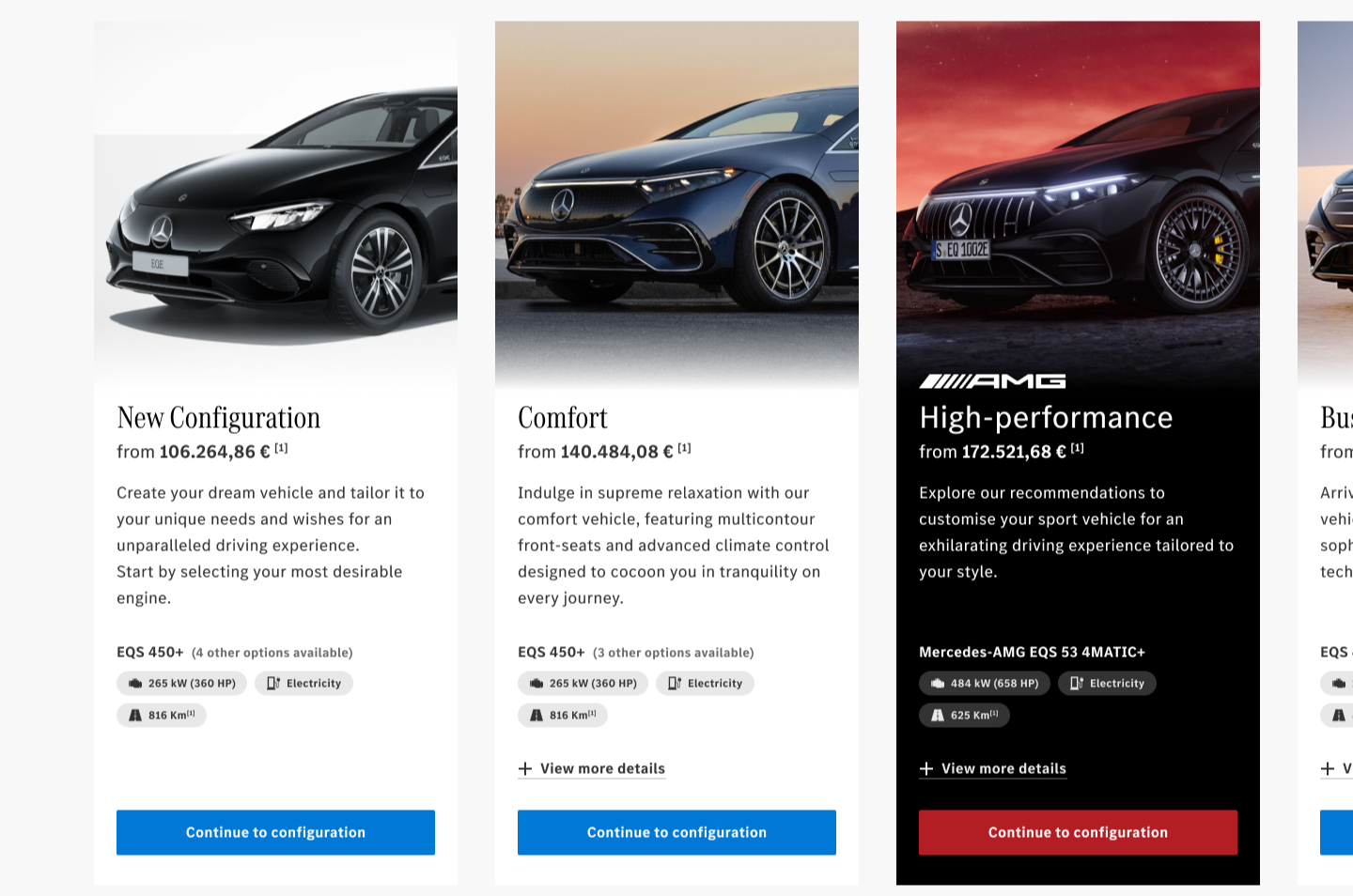
Research consistently showed that starting from a blank configuration could feel overwhelming.
Pre-configured concepts provided users with meaningful starting points instead of asking them to make every decision upfront.
Key decisions
Limit concepts to 3–5 options to avoid reintroducing overload
Anchor concepts around clear, concrete benefits (e.g. Efficiency, Comfort, Performance)
Keep concepts brand-agnostic and scalable across classes and sub-brands
02
Make differences visible early to support confident choice
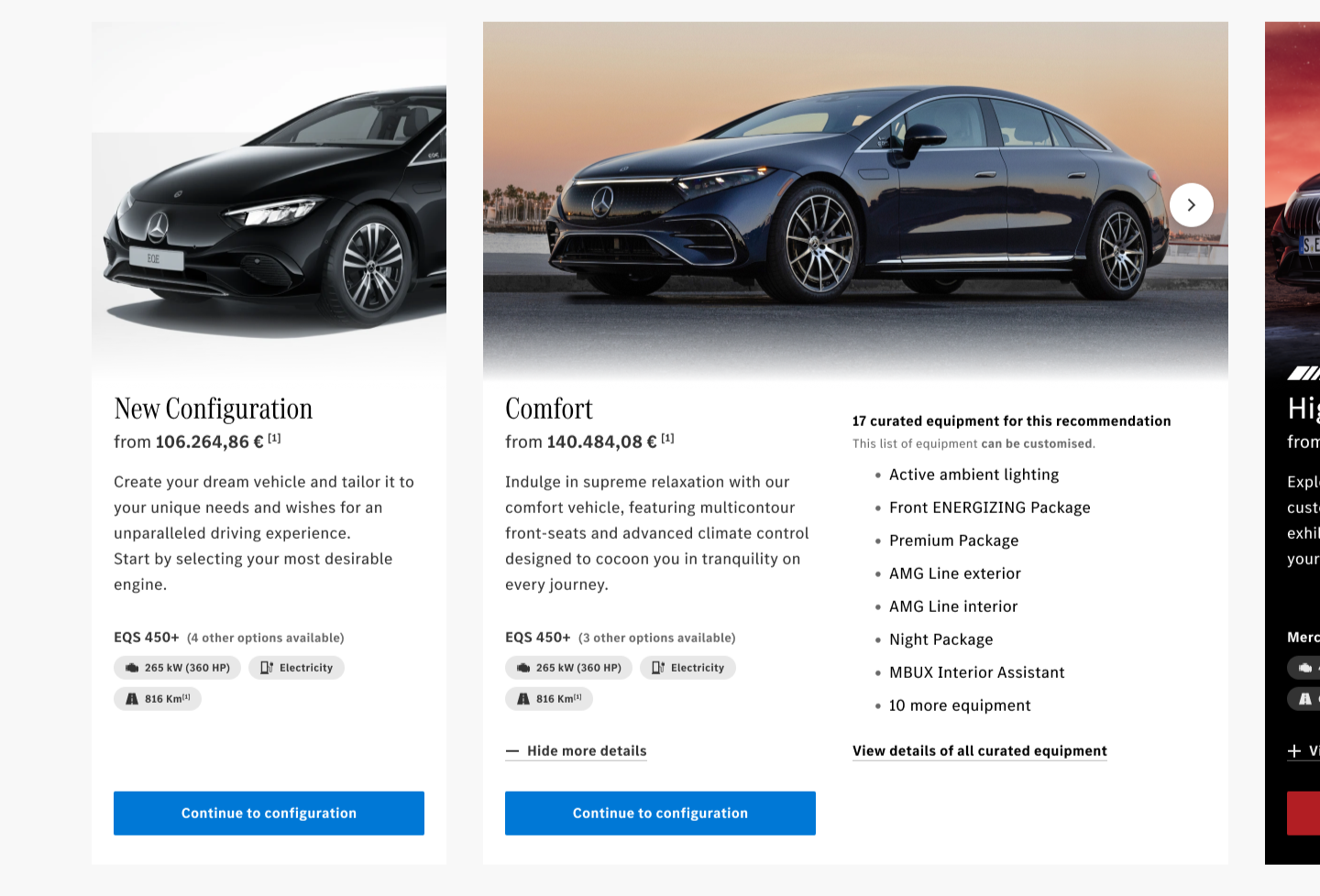
Testing showed that users wanted to understand how configurations differed before committing to one.
When those differences were not immediately clear, users had difficulty deciding which direction to take.
Key decisions
Surface price, engine specifications, and key equipment highlights upfront
Use descriptive naming rather than abstract or emotional labels
Support comparison without forcing users into deep configuration steps
03
Balance guidance with user control
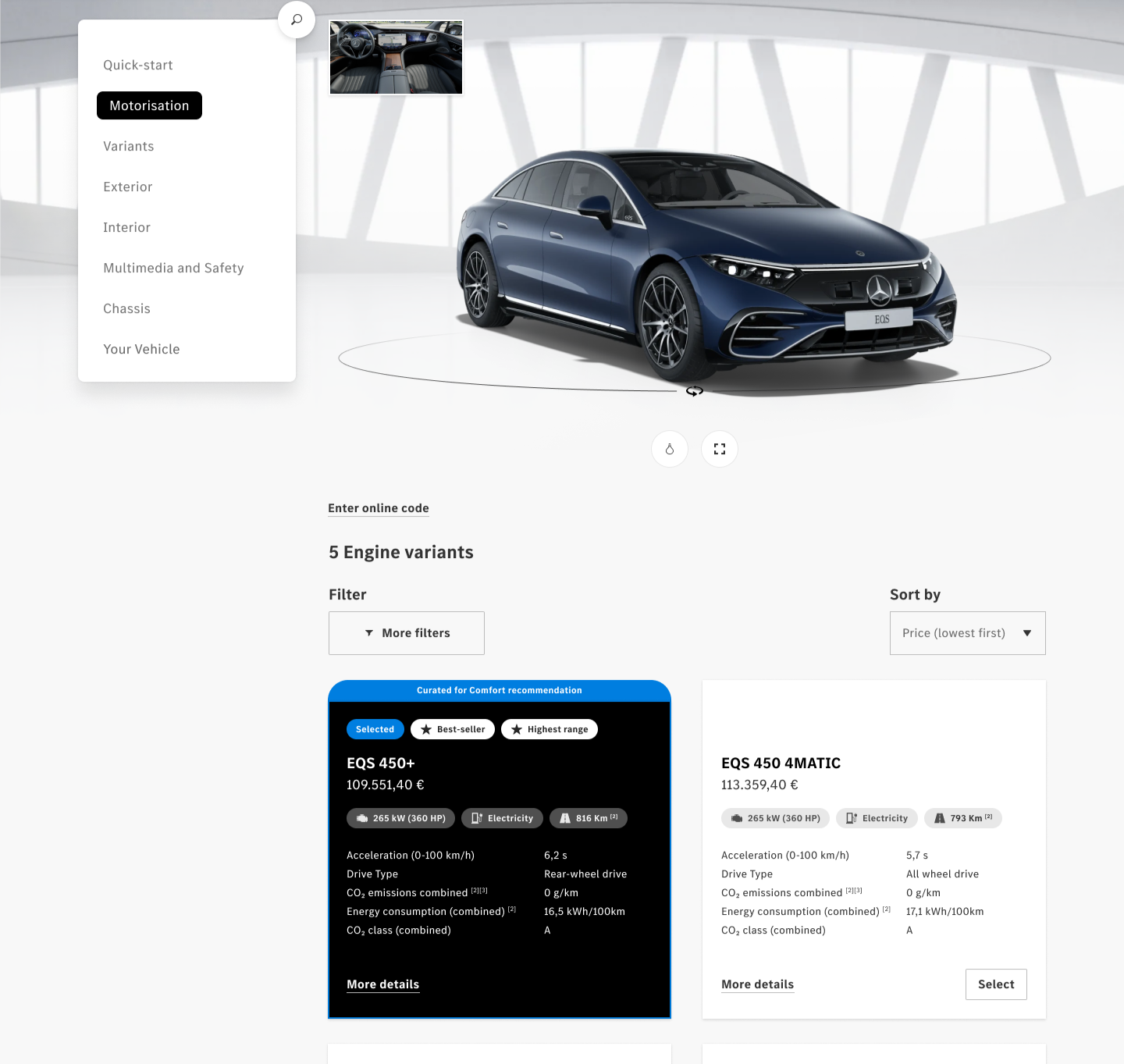
The guided approach needed to support decision-making without making users feel that they were losing options.
Key decisions
Keep the full configuration accessible at all times
Clearly position pre-configurations as starting points, not constraints
Use CTAs that reinforce agency (e.g. “Configure Performance”)
04
Reduce distraction and focus attention in the MVP
As the concept evolved, we identified opportunities to reduce unnecessary information early in the journey.
The MVP focused attention on the decisions that mattered most at each stage.
Key decisions
Simplify the start experience by removing non-essential elements
Prioritise clarity over richness in the MVP
Defer secondary information until after a configuration path is chosen
Designing the entry point around confident decisions
The design approach evolved around three principles:
Guide without restricting
Give users a meaningful starting point while keeping the full configuration journey available.
Make differences understandable
Help users recognise why one configuration is different from another before asking them to commit.
Reveal complexity progressively
Introduce detail when it becomes relevant instead of presenting the full complexity of the configurator upfront.
Designing for confidence at every step
01
Structure the entry point to reduce cognitive load
The starting point should help users make an initial decision, not expose the full complexity of the configurator immediately.
Design focus
Present a limited number of clearly differentiated concepts
Use strong hierarchy to make each option scannable
Prioritise clarity and recognisable value
02
Use progressive disclosure to support understanding
Information was intentionally revealed as users moved through the journey.
Design focus
Show price, engine type and key highlights upfront
Reveal detailed specifications through deeper exploration
Maintain a clear distinction between choosing a direction and configuring details
03
Reinforce user agency at every step
The experience should never feel like a dead end.
Design focus
Keep full configuration accessible
Clearly communicate the user's current position
Make it easy to change or refine choices
04
Design for MVP clarity, not feature completeness
The initial experience focused on helping users make the most important decisions before introducing additional complexity.
Design focus
Reduce competing entry points
Prioritise the most relevant information
Sequence information intentionally rather than presenting everything at once
From guided choice to detailed configuration
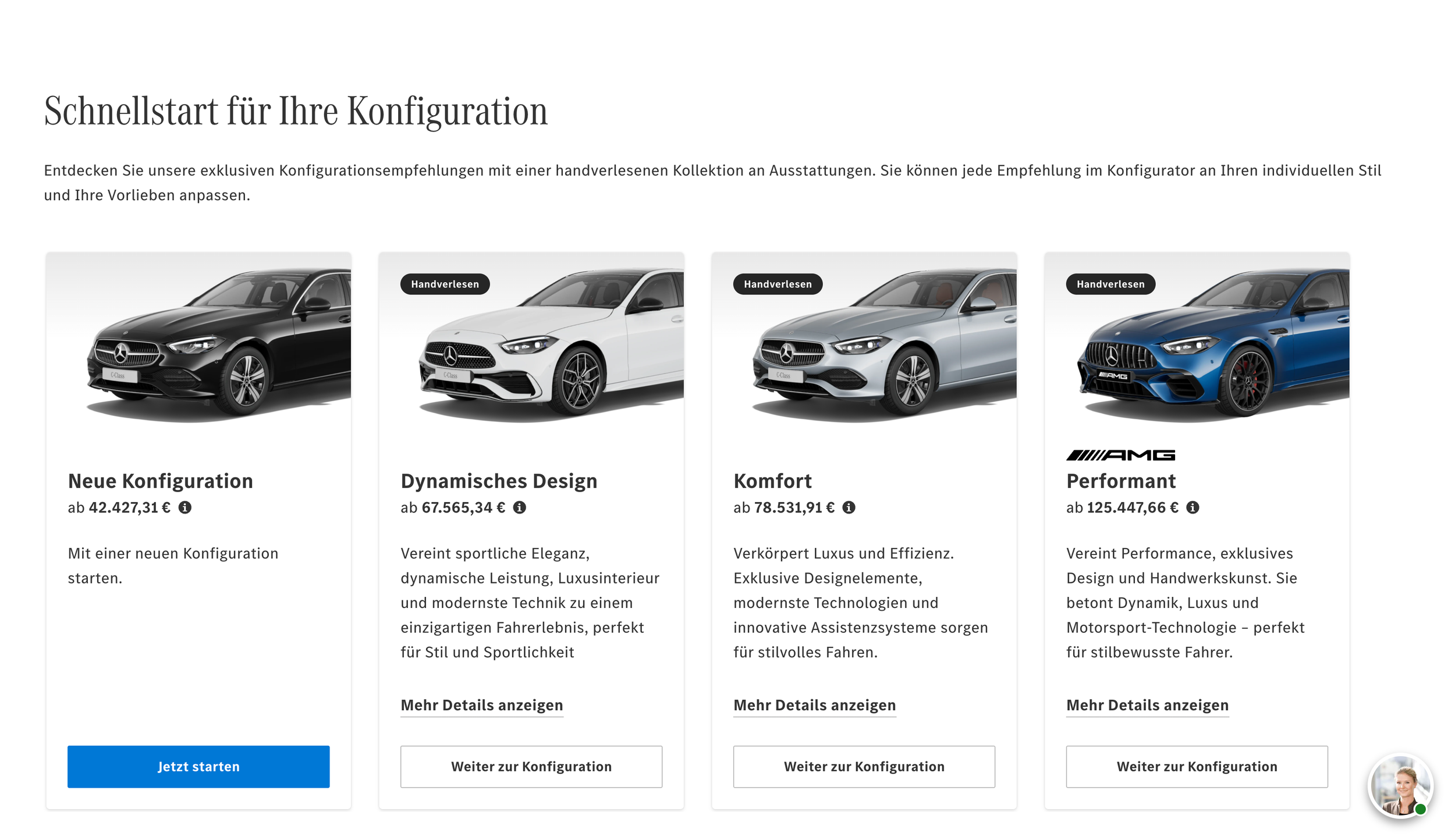
The final experience introduced curated starting points that helped users enter the configurator with a clearer sense of direction.
Rather than replacing the existing configuration journey, the new experience created a more approachable starting point.
The journey
Explore → Choose → Configure → Refine
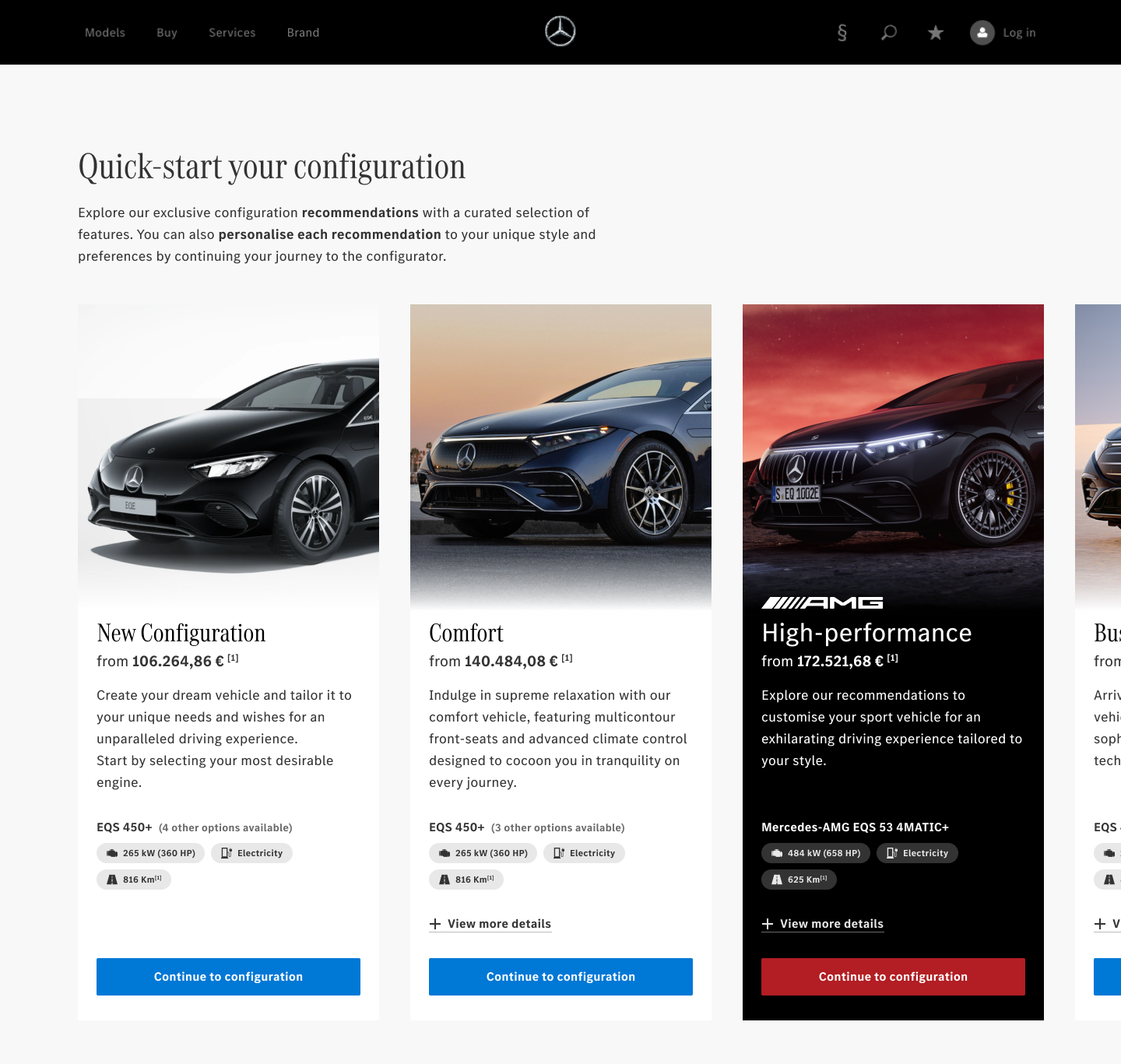
From concept to live experience
The solution was implemented as an MVP and deployed in a single market to validate the approach before broader rollout.
The MVP focused on:
Pre-configured vehicle concepts
Clear differentiation between starting points
Guided entry into the configurator
Maintaining access to the full configuration experience
You can see the MVP live for the Germany market here.
Impact
Turning guided choice into commercial value
The introduction of Pre-Configurations did more than simplify the starting point of the configuration journey. It also created a strong commercial opportunity by helping customers start from more valuable vehicle configurations.
30-50%
Above base vehicle price
Pre-Configurations are strongly associated with configurations 30–50% above the base vehicle price, contributing to millions of euros in generated lead value.
73% / 59%
Basic configuration selection
In C-Class and CLA, users more frequently started with the Basic Configuration — 73% and 59% respectively.
~30%
Top-tier recommendations
In premium classes such as S Maybach, AMG GT and AMG SL, users selected the most complete and luxurious Pre-Configurations around 30% of the time.
Easier completion
When starting from a recommendation
Users who selected a recommendation tended to complete the journey more easily, suggesting that guided starting points can reduce friction in a complex purchase decision.
What I learned about designing for choice
01
Guidance needs to feel earned
Recommendations work best when users can understand why they are relevant. The more transparent the choice, the easier it is for users to trust the starting point.
02
Personalisation happens after the first decision
A strong starting point doesn't need to anticipate every preference. Users can begin with a meaningful configuration and then make it their own through the details that matter to them.
03
Different users need different levels of guidance
The behaviour across vehicle classes showed that there isn't one ideal recommendation strategy. Price sensitivity, product positioning and user intent all influence how much guidance is valuable.
04
Business goals can strengthen UX decisions
The project showed me that commercial objectives don't have to compromise the user experience. When they are aligned with a genuine user need, in this case, reducing complexity, they can reinforce each other.
The takeaway
Good guidance can create value for both the customer and the business.
Pre-Configurations showed me that reducing complexity doesn't have to mean reducing choice. When guidance is relevant, transparent and flexible, it can help customers move through a complex decision with greater confidence — while also supporting meaningful commercial outcomes.
The goal isn't to guide users towards a specific choice. It's to make the right choice easier to understand.